The Decoherence via Demyelination Hypothesis

The Geography of Cognition

Cognitive aging is a question of timing.

Thought emerges from distant brain regions activating at exactly the right moment. As the insulation (myelin) on long-distance connections wears away — unevenly, over a lifetime — the timing slips, and the network falls out of sync.

Integration Memory Language Executive Vision Movement
Sound roads — sensory & motor Eroding roads — memory · language · executive
A preprint by Gershteyn, Markov, Olzinski, Kramer, Casaletto, Ellerby & Furman
UCSF Memory & Aging Center Buck Institute for Research on Aging Stanford University
Movement one

Thought is a choir, not a soloist.

Right now, as you read these words, thousands of neurons scattered across your brain are firing together as a choir.

The same thing happens when you plan your day, learn a new recipe, or recall a friend's face. None of these tasks lives in a single spot. Each comes from vast networks of neurons spread across distant regions; for their work to succeed, they must speak to each other at the right moment.

Movement two

The problem is distance.

These neurons are not next to each other. Some are quite far apart, with signals traveling by long, wire-like fibers called axons. A signal takes time to travel — the further it goes, the later it arrives.

For this network to work, signals traveling different distances must arrive at their destinations simultaneously. If they don't, the receiving neurons don't activate on time. Arriving too early or too late is like a choir section coming in on the wrong beat: the harmony collapses.

Movement three

Myelin paves the roads.

The brain solves the timing problem with myelinMyelinA fatty insulating sheath wrapped around nerve fibers that speeds up and stabilizes their signals.Full glossary entry → — a fatty sheath that wraps around axonsAxonThe long, wire-like fiber that carries a neuron's signal to distant cells.Full glossary entry → like insulation around an electrical cable. Myelin speeds transmission, and, crucially, can be tuned pathway by pathway.

Well-maintained myelin across long-distance connections ensures signals travel at precisely the right speed, so that inputs from regions near and far arrive simultaneously at their target. Neurons across the brain synchronize into a coherent, functional network.
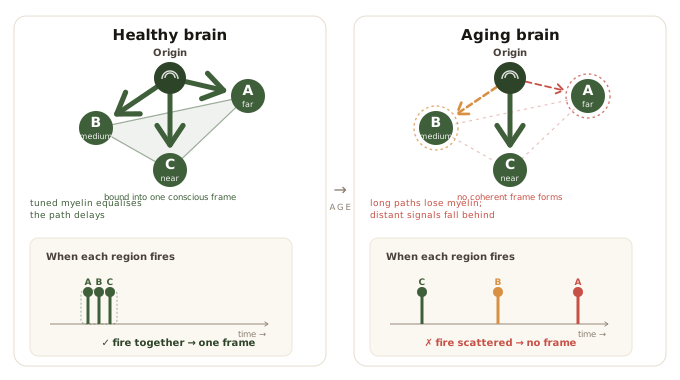
A coordinating signal travels from a shared origin out to three regions A (far), B (medium) and C (near). Left, healthy: tuned myelin makes all three fire at the same moment, binding into one conscious frame. Right, aging: the long paths to the far and medium regions have lost myelin, so those regions fire late, the firing scatters, and no coherent frame forms.
The figure Firing together makes a thought. A coordinating signal reaches three regions at different distances. When the roads are sound (left), well-tuned myelin equalises the travel times so all three fire at the same moment — and that simultaneous firing is what binds them into a single conscious frame. When the long roads lose myelin (right), the distant regions fire late; the firing scatters across time, and no coherent frame forms. The regions are unchanged — it is the timing of the roads between them that fails.

What "arriving on time" really means

A receiving region only listens during brief, rhythmic windows. A signal that lands inside the open window (green) is heard; one that arrives late (after myelin loss slows it) lands in the closed window and is effectively ignored.

Targetits rhythm
On timewell-myelinated
Too latedemyelinated

On time: the pulse peaks inside the open window and the message gets through. Too late: the same pulse, slowed by worn insulation, peaks after the window has closed — and the network misses it.

Movement four

With age, the roads wear unevenly.

As we age, myelin is progressively lost along the brain's pathways — a process called demyelinationDemyelinationThe loss of the myelin sheath around nerve fibers, slowing and de-tuning their signals.Full glossary entry → — and the loss is not even. The connections that wear fastest are precisely those linking the regions of memory, language, and executive thought.

When myelin thins, signals slow or scatter (they decohere). The carefully tuned timing falls apart. Inputs that once arrived together now arrive smeared across time, and the network can no longer hold itself in sync. The long inter-city highways crumble first; the short local streets of vision and movement stay sound the longest.

Higher-order tracts age non-linearly

In the association and limbic pathways that serve memory and reasoning, fibre integrity holds up — even edging higher — through midlife, then declines at an accelerating rate after about age 60. In the paper, 15 of 28 tracts (including the uncinate fasciculus, fornix and corpus callosum) were best fit by this non-linear, accelerating shape.

Illustrative schematic of the non-linear “hill-and-valley” trajectory the paper reports for vulnerable association tracts — not measured data. The preprint’s Figure 2 shows the real per-tract scatter and model fits.

The geographic signature

Which roads wear first

Not every route ages alike. The long highways serving memory, language and executive thought lose integrity fastest; the short, early-paved roads of movement and sensation are largely spared — the geographic signature at the heart of the hypothesis.

Uncinate fasciculusfrontal ↔ temporal · memory, emotion
fast
Fornixhippocampal output · memory
fast
Corpus callosum (genu)interhemispheric · integration
mid
Superior longitudinal fasc.fronto-parietal · attention
mid
Optic radiationthalamus ↔ visual cortex
slow
Corticospinal tractmotor output · movement
slow
Relatively sparedDeclines fastest

Bars show the relative rate of age-related integrity loss across representative tracts. Higher-order association highways (coral) wear fastest; primary sensory and motor roads (green) wear slowest — illustrative ordering consistent with the diffusion-MRI findings.

Movement five

Decoherence via Demyelination.

This is the core idea: age-related cognitive decline is, in significant part, a timing problem.

The brain's ability to coordinate distant regions into coherent networks gradually erodes as the insulation on its long-distance cables wears away — and with it goes the fluid thinking and ready memory that define a sharp mind.

The cities of the mind remain. It is the roads between them that wear away.

That distinction matters. If decline were the death of neurons, there would be little to do. But if it is the insulation on the connections — a maintained, plastic, living tissue — then the target for protecting the aging mind shifts from the cities to the roads.

Movement six

Roads can be repaved.

If the problem were dying neurons, there would be little to do. Because it is the insulation — living, maintained, renewable tissue — the target changes entirely.

Myelin is not laid down once and left to decay. The brain rebuilds it throughout life, and that opens a different class of approaches to protecting the aging mind — aimed not at the cities, but at keeping their roads in good repair.

01

Maintain the myelin

Protect and repair the insulating sheath itself, slowing the loss of conduction timing.

02

Support the road crews

Sustain the oligodendrocytesOligodendrocytesThe glial cells that build and maintain myelin in the central nervous system.Full glossary entry → that build and renew myelin.

03

Cool the inflammation

Reduce the inflammatory signaling that damages myelin-producing cells with age.

04

Use it to keep it

Cognitive and physical engagement may drive natural remyelination — activity that paves the roads it travels.

These are directions the framework points toward, not proven therapies. What makes them worth pursuing is the shift in target: from loss that cannot be undone to infrastructure that can be maintained.

For scientists

A network-timing account of cognitive aging.

The same idea, stated mechanistically — integrating communication-through-coherence with activity-dependent myelin plasticity, and tested against the structural record of the aging human brain.

Cognition as emergent network activity

Function lives in the network, not the node.

Over two decades, systems neuroscience has moved the locus of cognition away from isolated cortical centers toward the emergent dynamics of large-scale distributed networks. Executive control, working memory, episodic recall, language, and attention are properties of transient, task-dependent assemblies drawn from multiple, often anatomically remote regions. High-density recordings show these assemblies span dozens of areas at once; higher performance correlates with more coordinated recruitment across networks rather than stronger activation in any single node.

The challenge this architecture imposes is timing. Populations communicate effectively when their activity is coherent — when signals arrive in phase with the local oscillatory stateOscillatory synchronyBrain regions firing in coordinated rhythms; communication succeeds only when signals arrive in phase.Full glossary entry → of the target. Under the communication-through-coherence framework (Fries, 2005, 2015), selective inter-areal communication depends on aligning long-distance projections with local oscillatory windows. When multiple projections of unequal length must converge on a common target, coherent arrival requires not just phase alignment but precise equalization of conduction latenciesConduction velocityHow fast a signal travels down an axon — set largely by its myelination.Full glossary entry → across pathways.

Myelin as the timing substrate

Insulation tuned axon-by-axon.

The principal mechanism for conduction-timing precision is myelination. Myelin sheaths, produced by oligodendrocytesOligodendrocytesThe glial cells that build and maintain myelin in the central nervous system.Full glossary entry →, raise conduction velocity through saltatory propagationSaltatory conductionSignals leaping between gaps in the myelin, traveling far faster than on a bare fiber.Full glossary entry → and reduce temporal jitterTemporal jitterRandom variation in arrival times; myelin minimizes it to keep signals in phase.Full glossary entry →, preserving the phase relationships that inter-regional synchrony requires. Myelination is not uniform: it is regulated at the level of individual axon segments, so the nervous system can in principle tune conduction velocities pathway-by-pathway such that near and far signals arrive contemporaneously. Pajevic, Basser & Fields (2014, 2023) formalized this, showing that oligodendrocyte-mediated myelin plasticity could maintain the synchronization patterns large-scale networks need — a complement to Hebbian plasticity that operates on the edges of the neural graph rather than its vertices.

Developmental trajectory

A white-matter scaffold sculpted by experience.

Myelination of long-range cortico-cortical projections follows a protracted, experience-sensitive schedule, with fine-tuning of association fibers continuing into the third decade of life. Oligodendrocyte precursor cells respond to axonal activity by proliferating and preferentially ensheathing active axons — a feedback loop in which cognitive engagement shapes the substrate enabling future efficiency. The three lifespan waves of myelin change — establishment, maturation, atrophy — align with the peak-risk windows for neurodevelopmental, psychiatric, and neurodegenerative pathology respectively, and genes tied to each are enriched in oligodendrocyte-lineage cells, marking this population as a convergence point for brain health across life.

The hypothesis

The Decoherence via Demyelination Hypothesis.

DDH posits a specific mechanistic chain: heterogeneous, tract-specific loss of myelin integrity in long-range projections during normal aging degrades conduction-timing precision, disrupts the inter-regional coherence required for task-dependent network assembly, and thereby produces the cognitive deficits of normative aging. Because demyelination is uneven rather than global, it asymmetrically impairs subsets of functional sub-networks — progressively eroding the brain's capacity to reconfigure coherent assemblies on demand — while relatively sparing primary sensorimotor circuits, whose shorter, earlier-myelinating projections are less vulnerable.

Structural evidence

What the aging brain actually shows.

Diffusion-weighted MRI from 638 adults aged 40–99 (UCSF Brain Aging Networks for Cognitive Health, BrANCH) reveals heterogeneous, predominantly nonlinear age-related decline across 28 white-matter tracts — strongest in higher-order association and limbic pathways (uncinate fasciculus, fornix, corpus callosum), modest in primary motor tracts such as the corticospinal tract, exactly as DDH predicts. Crucially, NODDINODDIAn advanced diffusion-MRI model that separates fiber density from surrounding free water.Full glossary entry → modeling of superficial white matter under 34 cortical regions dissociates the cause:

Young white matterDense neurites, intact myelin, little free water.
Aging white matterFewer neurites & thinner myelin, more free water — yet the fibers that remain still point the same way.
ficvficv — intracellular volumeThe fraction of tissue occupied by neurites; falls as myelinated volume is lost.Full glossary entry →
Intracellular volume
Falls with age — less space occupied by intact, myelinated tissue.
fisofiso — free waterThe isotropic free-water fraction; rises as extracellular space expands.Full glossary entry →
Free water
Rises with age — extracellular space expands as sheaths degrade.
ODIODI — orientation dispersionHow much fiber directions spread; near-constant here, so axons are not dropping out.Full glossary entry →
Orientation dispersion
Largely unchanged — fibers stay correctly oriented; axons are not dropping out.

The roads lose their surface; the routes remain. Free water rises and intracellular volume falls, but fiber orientation holds — the signature of myelin loss, not axons dropping out.

638
adults, ages 40–99
28
white-matter tracts mapped
R = 0.72
single axis linking structure to cognition
~60
age where decline accelerates
What this shows — and what it doesn’t.

These findings are cross-sectional and correlational: a single snapshot of 638 adults, not the same brains followed over time. They establish that the structural signature DDH predicts is present in the aging human brain — demyelination-consistent change, concentrated in the most vulnerable long-range tracts, tracking cognition along a single dominant axis.

They do not, on their own, prove causation. Establishing that timing loss drives decline will require longitudinal imaging, interventional remyelination studies, and converging evidence across cohorts. We present DDH as a framework with strong structural support and clear, testable predictions — not a settled result. The full methods and limitations are laid out in the preprint.

Cohort UCSF Brain Aging Networks for Cognitive Health (BrANCH) · 638 adults, ages 40–99 Data & code Synapse syn75115498 · github.com/NikolaTMarkov/DDH Funding NIH NIA P01AG066591, T32-AG000266 · Hevolution Foundation

Go further.

Three ways into the work, by how deep you want to go.

@article{gershteyn2026ddh,
  title   = {Decoherence via Demyelination Hypothesis (DDH): A Mechanism of Cognitive Decline During Aging},
  author  = {Gershteyn, Iosif M. and Markov, Nikola T. and Olzinski, Molly and Kramer, Joel and Casaletto, Kaitlin B. and Ellerby, Lisa M. and Furman, David},
  year    = {2026},
  journal = {bioRxiv},
  doi     = {10.64898/2026.05.22.727307}
}
Gershteyn, I. M., Markov, N. T., Olzinski, M., Kramer, J., Casaletto, K. B., Ellerby, L. M., & Furman, D. (2026). Decoherence via Demyelination Hypothesis (DDH): A mechanism of cognitive decline during aging [Preprint]. bioRxiv. https://doi.org/10.64898/2026.05.22.727307
Gershteyn IM, Markov NT, Olzinski M, Kramer J, Casaletto KB, Ellerby LM, Furman D. Decoherence via Demyelination Hypothesis (DDH): A Mechanism of Cognitive Decline During Aging. bioRxiv. 2026. doi:10.64898/2026.05.22.727307