Thought is a choir, not a soloist.
Right now, as you read these words, thousands of neurons scattered across your brain are firing together as a choir.
The same thing happens when you plan your day, learn a new recipe, or recall a friend's face. None of these tasks lives in a single spot. Each comes from vast networks of neurons spread across distant regions; for their work to succeed, they must speak to each other at the right moment.
The problem is distance.
These neurons are not next to each other. Some are quite far apart, with signals traveling by long, wire-like fibers called axons. A signal takes time to travel — the further it goes, the later it arrives.
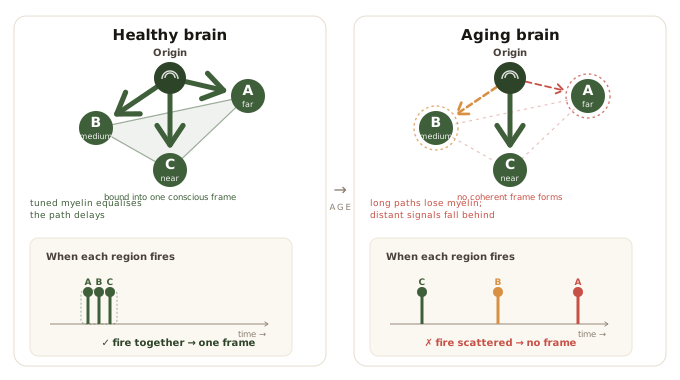
For this network to work, signals traveling different distances must arrive at their destinations simultaneously. If they don't, the receiving neurons don't activate on time. Arriving too early or too late is like a choir section coming in on the wrong beat: the harmony collapses.
Myelin paves the roads.
The brain solves the timing problem with myelinMyelinA fatty insulating sheath wrapped around nerve fibers that speeds up and stabilizes their signals.Full glossary entry → — a fatty sheath that wraps around axonsAxonThe long, wire-like fiber that carries a neuron's signal to distant cells.Full glossary entry → like insulation around an electrical cable. Myelin speeds transmission, and, crucially, can be tuned pathway by pathway.
Well-maintained myelin across long-distance connections ensures signals travel at precisely the right speed, so that inputs from regions near and far arrive simultaneously at their target. Neurons across the brain synchronize into a coherent, functional network.
What "arriving on time" really means
A receiving region only listens during brief, rhythmic windows. A signal that lands inside the open window (green) is heard; one that arrives late (after myelin loss slows it) lands in the closed window and is effectively ignored.
On time: the pulse peaks inside the open window and the message gets through. Too late: the same pulse, slowed by worn insulation, peaks after the window has closed — and the network misses it.
With age, the roads wear unevenly.
As we age, myelin is progressively lost along the brain's pathways — a process called demyelinationDemyelinationThe loss of the myelin sheath around nerve fibers, slowing and de-tuning their signals.Full glossary entry → — and the loss is not even. The connections that wear fastest are precisely those linking the regions of memory, language, and executive thought.
When myelin thins, signals slow or scatter (they decohere). The carefully tuned timing falls apart. Inputs that once arrived together now arrive smeared across time, and the network can no longer hold itself in sync. The long inter-city highways crumble first; the short local streets of vision and movement stay sound the longest.
Higher-order tracts age non-linearly
In the association and limbic pathways that serve memory and reasoning, fibre integrity holds up — even edging higher — through midlife, then declines at an accelerating rate after about age 60. In the paper, 15 of 28 tracts (including the uncinate fasciculus, fornix and corpus callosum) were best fit by this non-linear, accelerating shape.
Illustrative schematic of the non-linear “hill-and-valley” trajectory the paper reports for vulnerable association tracts — not measured data. The preprint’s Figure 2 shows the real per-tract scatter and model fits.
Which roads wear first
Not every route ages alike. The long highways serving memory, language and executive thought lose integrity fastest; the short, early-paved roads of movement and sensation are largely spared — the geographic signature at the heart of the hypothesis.
Bars show the relative rate of age-related integrity loss across representative tracts. Higher-order association highways (coral) wear fastest; primary sensory and motor roads (green) wear slowest — illustrative ordering consistent with the diffusion-MRI findings.
Decoherence via Demyelination.
This is the core idea: age-related cognitive decline is, in significant part, a timing problem.
The brain's ability to coordinate distant regions into coherent networks gradually erodes as the insulation on its long-distance cables wears away — and with it goes the fluid thinking and ready memory that define a sharp mind.
That distinction matters. If decline were the death of neurons, there would be little to do. But if it is the insulation on the connections — a maintained, plastic, living tissue — then the target for protecting the aging mind shifts from the cities to the roads.
Roads can be repaved.
If the problem were dying neurons, there would be little to do. Because it is the insulation — living, maintained, renewable tissue — the target changes entirely.
Myelin is not laid down once and left to decay. The brain rebuilds it throughout life, and that opens a different class of approaches to protecting the aging mind — aimed not at the cities, but at keeping their roads in good repair.
Maintain the myelin
Protect and repair the insulating sheath itself, slowing the loss of conduction timing.
Support the road crews
Sustain the oligodendrocytesOligodendrocytesThe glial cells that build and maintain myelin in the central nervous system.Full glossary entry → that build and renew myelin.
Cool the inflammation
Reduce the inflammatory signaling that damages myelin-producing cells with age.
Use it to keep it
Cognitive and physical engagement may drive natural remyelination — activity that paves the roads it travels.
These are directions the framework points toward, not proven therapies. What makes them worth pursuing is the shift in target: from loss that cannot be undone to infrastructure that can be maintained.